
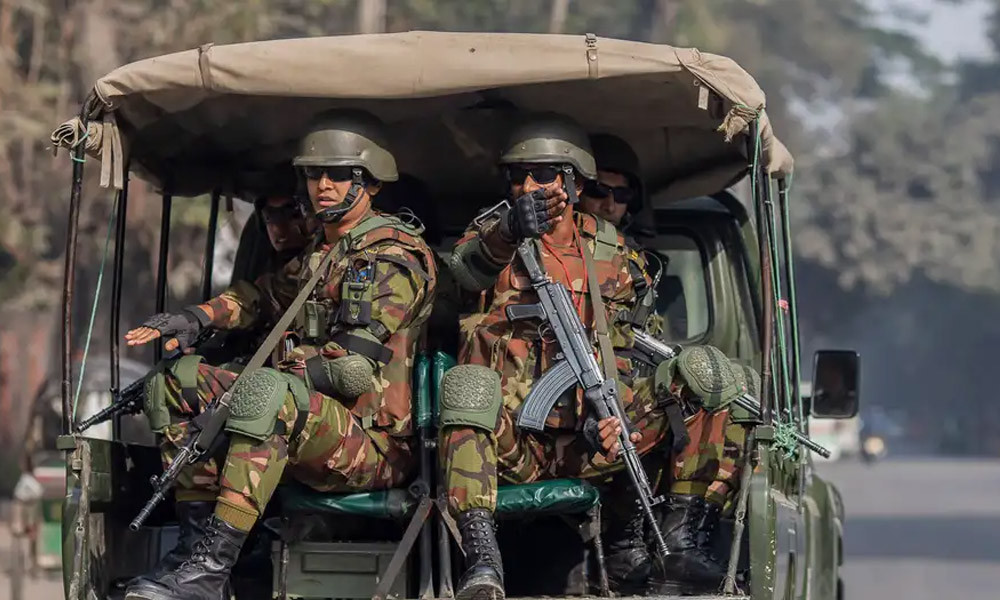
The Responsible Role of the Army in the Election Is Commendable
In a democratic system, an election is not merely a constitutional formality; it reflects public trust, state stability, and the maturity of political culture. How free, fair, and peaceful an election is depends on administrative efficiency, the law-and-order situation, and the responsible conduct of all stakeholders involved. In the recent election, the responsible and professional role of the Bangladesh Army in maintaining law and order was particularly noteworthy. Their presence significantly strengthened stability and confidence in the electoral environment—this is undeniable.
In Bangladesh’s political reality, elections often create concerns about tension, conflict, or unexpected incidents. Fears of polling station takeovers, violence, intimidation, or sabotage can cause anxiety among ordinary voters. In such circumstances, the neutral and restrained presence of the army fosters a sense of security among voters. Especially in remote or high-risk areas, their patrols and deployment helped ensure that the voting process remained uninterrupted.
An important aspect here is professionalism. Although the army did not directly manage the electoral process, its coordinated role in assisting the civil administration and maintaining law and order was clearly visible. In carrying out their duties, they demonstrated restraint, discipline, and neutrality—qualities that are essential in a democratic state. Without allegations of bias, their primary priority remained ensuring security.
Confidence in the electoral environment is a fundamental element. If voters do not feel safe, participation declines; and when participation declines, the credibility of the election is questioned. In many instances, the presence of the army helped bridge that gap in confidence. From rural areas to urban centers, their patrols and preparedness conveyed a clear message to the public: the state was committed to maintaining control over the situation.
It is important to remember that the Election Commission is the sole constitutional authority responsible for conducting elections. The role of the army was supportive in nature. The success of this supportive role largely depended on coordination with the civil administration. In the recent election, such coordination appeared satisfactory, enabling the maintenance of relatively stable law and order. The army’s ability to work in coordination with the administration, police, and other forces reflects its institutional competence.
At the same time, while appreciation is warranted, a balanced perspective is also necessary. In a democratic framework, all security activities must remain under civilian authority. The involvement of the army should always be limited to a specific timeframe and clearly defined responsibilities—this is important as a matter of principle. In the long term, strong civilian institutions form the foundation of democracy. The army’s role becomes commendable when it operates within professional and constitutional boundaries—something reflected in the recent experience.
Beyond ensuring security, another critical issue during elections is respect for human rights and civil liberties. Creating an environment where voters can freely go to polling centers, cast their votes, and accept the results is essential. In this regard as well, the restrained conduct of security forces plays a vital role. Avoiding unnecessary use of force and demonstrating patience according to the situation are hallmarks of a mature institution. From this perspective, the army’s role is being viewed positively.
There are lessons to be drawn for the future. Election-centered security management can be made more technology-driven and data-based. If high-risk areas are identified in advance and coordinated planning is undertaken, the burden on the army and other forces can be reduced while increasing effectiveness. At the same time, political parties also bear responsibility for maintaining a peaceful environment and encouraging their supporters to act with restraint.
In conclusion, a fair election is not limited to polling day; it is a process that requires maintaining trust and discipline at every stage. In that process, the responsible presence of the army played a significant role. Their professionalism and neutrality contributed to maintaining a stable electoral environment, setting a positive example for democratic practice.
The strength of democracy lies in public participation and trust. To preserve that trust, every state institution must fulfill its responsibilities properly. In the recent election, the responsible role of the army stands as a notable example of such coordinated efforts—one that may inspire future election management as well.