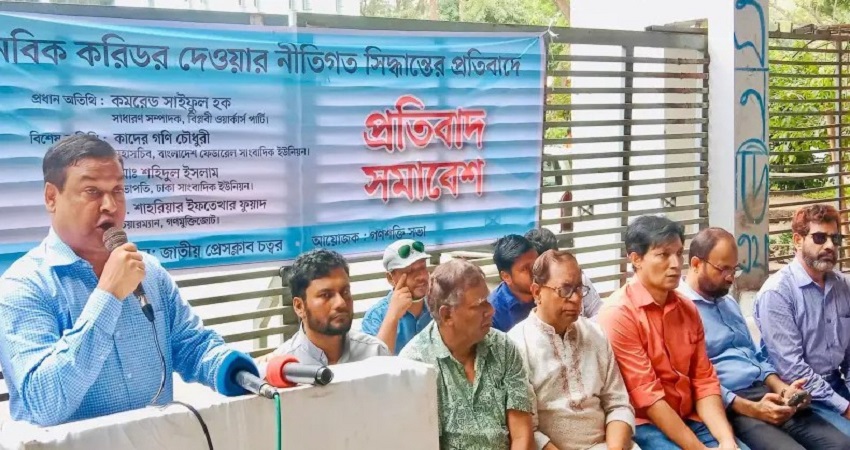
Secretary General of the Bangladesh Federal Journalists Union, Kader Gani Chowdhury, has raised serious concerns regarding the government’s policy decision to establish a humanitarian corridor with Myanmar. He warned that such a move could threaten the independence and sovereignty of Bangladesh. Speaking at a protest rally organized by the “People’s Power Assembly” in front of the National Press Club, Kader Gani emphasized that any decision of this magnitude should come directly from the people through a democratically elected parliament, not from an interim government.
The rally was held to protest the government’s policy to open a humanitarian corridor for Myanmar, a move many fear may compromise national security. The event was presided over by Dr. Shahriar Iftekhar Fuad and featured speakers including Saiful Haque, General Secretary of the Revolutionary Workers Party; Shahidul Islam, President of the Dhaka Journalists Union; AKM Mohsin, President of the Bangladesh Photojournalists Association and freedom fighter; and Shahin Hasnat of the Journalists Welfare Trust. The program was moderated by Sadekur Rahman.
Kader Gani Chowdhury highlighted that humanitarian corridors established in various conflict zones globally have often led to security vulnerabilities rather than solutions. He noted incidents where peacekeeping forces were absent, resulting in attacks on civilians within the corridors. There have been cases of corridors being targeted, with infrastructure destroyed and civilians killed. He also warned that such corridors are frequently exploited for political and military purposes, including arms smuggling and fuel trafficking in contested areas.
Chowdhury pointed out that the success of a humanitarian corridor depends on multiple factors, chiefly the agreement of all conflicting parties involved. Without consensus, corridors tend to fail. For instance, the Lachin corridor between Armenia and Azerbaijan, established in 1989, was closed by the Azerbaijani government within two years. Similarly, the United Nations Security Council’s declaration of safe zones in the 1990s in Bosnia failed to prevent the 1995 Srebrenica genocide due to a lack of clear protection mechanisms.
He also cited Yemen, where repeated calls for humanitarian corridors during ongoing conflict have not yielded success. In Congo, the UN’s attempt to open a corridor in Goma in 2008 amidst violent clashes also ultimately failed due to complex military factors.
Kader Gani Chowdhury stressed that establishing a corridor between Bangladesh and Myanmar could create significant security risks. The Arakan Army is actively engaged in armed conflict against the Myanmar military. If the Myanmar government perceives that the corridor benefits the Arakan Army, it may react aggressively, endangering Bangladesh’s security. Thus, instead of a relief pathway, the corridor could become a source of conflict and danger.
Saiful Haque, General Secretary of the Revolutionary Workers Party, described the UN-proposed humanitarian corridor in Rakhine as a geopolitical maneuver aimed at laying the groundwork for international military intervention. He warned that this could pose long-term strategic risks for Bangladesh. He further explained that discussions about establishing a “safe zone” in Rakhine involve plans not only for humanitarian aid but also for creating a controlled territory. This process may bring pressure on Bangladesh to participate militarily, raising concerns over sovereignty and security.
The establishment of a Bangladesh-Myanmar humanitarian corridor is a complex issue with deep implications for national security and sovereignty. While the intention to provide humanitarian aid is commendable, experts warn that without clear political consensus and security guarantees, such a corridor may expose Bangladesh to significant risks. Political transparency, public consensus, and thorough risk assessment are crucial before moving forward with this sensitive initiative.